Lower Paxton Roofing provides commercial roofing in Lower Paxton, PA, with more than 20 years of roofing behind us, serving surrounding cities including Linglestown, Progress, Susquehanna Township, Harrisburg and Hummelstown. Our commercial work centers on low-slope roofs: offices, retail, apartment buildings, churches, small warehouses and the flat sections on mixed-use buildings.
Commercial roofs fail differently from houses. The trouble is rarely the open field of the membrane; it is the seams, the drains, the curbs around rooftop units and the flashing at parapets and walls. We inspect those first, document what we find with photos, and give owners and property managers a written scope that separates every component of the work. Whether the building needs a repair, a recover or a full replacement, the recommendation comes with the evidence behind it.
Commercial Roof Membranes
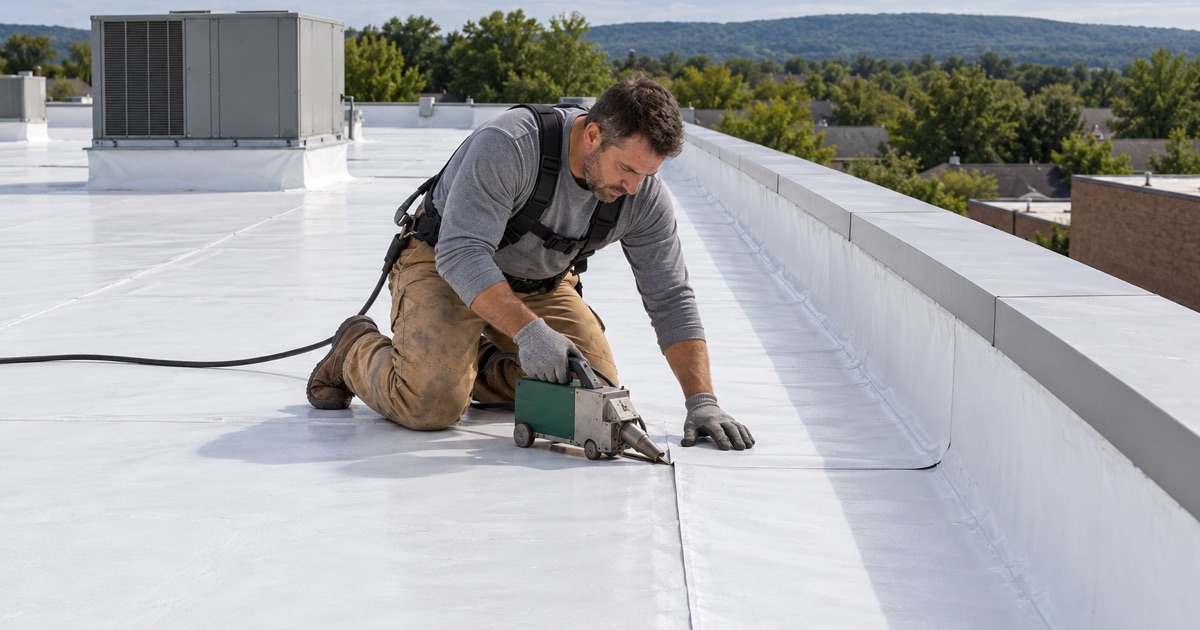
TPO and PVC Single-Ply Membranes
TPO and PVC single-ply membranes are installed in wide sheets with heat-welded seams, which fuse into a single watertight surface. Their white or light-colored surfaces reflect sunlight and help keep the building below cooler. They suit many offices, retail buildings and apartment roofs where the roof sees moderate foot traffic.
Heat-welded seams are strong when they are done right, so we probe every seam after welding rather than assuming it bonded. On repairs, a TPO roof is patched with TPO and welded, never covered with a mismatched product that will peel.
EPDM Rubber Membrane
EPDM is a synthetic rubber membrane with a long track record on low-slope roofs. It tolerates building movement and temperature swings well, and it is installed either fully adhered or mechanically attached. Seams are joined with seam tape and primer, and those seams are where an aging EPDM roof usually needs attention.
EPDM repairs need clean, primed surfaces and compatible tapes and flashings. Many failed EPDM patches we see were made with general roofing cement, which does not bond to rubber and lets water travel underneath.
Modified Bitumen
Torch-down SBS and APP modified bitumen is built up in layers, fused together, with a granulated or coated cap sheet on top. It stands up to foot traffic well, which makes it a good choice around rooftop equipment that is serviced often. It is also common on smaller commercial buildings and multifamily roofs in older neighborhoods.
Because modified bitumen is often torch-applied, fire safety is part of the job. Torch work near parapets, wood nailers and rooftop equipment is planned in advance, and in sensitive areas we use self-adhered or cold-applied sheets instead of an open flame.
Commercial Roof Repairs
Seams, Blisters and Splits
Open seams, blisters and splits are the most common membrane failures. A blister may be trapped moisture or a loss of adhesion, and cutting it open without understanding which can make things worse. We probe the surrounding area, check whether the insulation below is wet, and repair the membrane with material from the same family as the existing roof.
Curbs, Penetrations and Rooftop Equipment
HVAC curbs, exhaust fans, pipe penetrations and conduit supports all pierce the membrane, and their flashing is where many commercial leaks begin. We reflash curbs, replace pitch pans with prefabricated boots where possible and coordinate with mechanical contractors when equipment has to be lifted or disconnected to reach the flashing underneath.
Old rooftop equipment leaves its own problems behind. Abandoned curbs, cut-off pipes and unused supports remain as holes waiting to leak, so where an owner agrees, we remove them and patch the deck and membrane rather than flashing around equipment that no longer serves the building.
Drains, Scuppers and Ponding
Water sitting on a low-slope roof for days after rain stresses the membrane, adds weight and finds every weakness. We clear and inspect roof drains and scuppers, repair drain flashing and identify low spots where water collects. Where ponding is persistent, tapered insulation or added drains can be included in the scope to get water moving off the roof.
Debris blocking a drain is the cheapest commercial roof problem to fix and one of the most damaging to ignore. Leaves and grit in a single blocked drain can back water up across a whole section, so drain cleaning is part of every maintenance visit we make.
Commercial Roof Replacement
Tear-Off or Recover
A recover installs a new membrane over the existing roof, while a tear-off removes everything down to the deck. A recover can save cost when the existing insulation is dry and the deck is sound. Wet insulation has to come out, because sealing it under a new membrane traps moisture against the deck. We check moisture conditions before recommending either approach.
Insulation, Edges and Drainage
A replacement is the chance to fix the problems the old roof had. We include insulation, tapered sections for drainage, new edge metal and coping, and new flashing at every wall and curb. The scope lists each item separately, so an owner can see what the roof is made of and compare bids on substance.
Scheduling Around an Occupied Building
Commercial roofs are replaced over working buildings. We phase the work so each section is dried in before the crew leaves, keep walkways and entrances clear, and communicate the schedule to tenants through the owner or manager. Daily clean-up includes the ground around the building as well as the roof.
Documentation for Owners and Managers
Photo Reports and Written Scopes
Every commercial inspection, repair and replacement comes with a photo record and a written scope. A property manager can forward it to an owner, an association board or an insurer without anyone needing to climb the roof. When storm damage is involved, we document it for the owner’s own claim and will meet the adjuster on site when asked.
The same documentation helps with long-term planning. A roof inspected and recorded each year builds a history that shows which areas are aging, so repair and replacement can be budgeted rather than handled as emergencies.
Permits and Plans
Commercial roofing falls under the Pennsylvania Uniform Construction Code, and the residential repair exemption does not cover commercial buildings. We confirm the permit requirements with the municipality before scheduling a replacement, and the permit cost appears as its own line on the estimate.
- 20+ Years Roofing
- Itemized Written Scopes
- Repair Before Replace