
Lower Paxton Roofing has handled roof leak repair in Lower Paxton, PA for more than 20 years, serving surrounding cities including Linglestown, Progress, Susquehanna Township, Harrisburg and Hummelstown. A leak call is a diagnosis first and a repair second, and the diagnosis is where most leak repairs go wrong.
Water that gets through a roof seldom drips straight down. It runs along the top of the sheathing, follows rafters and pools on top of drywall before it finally shows, sometimes several feet from where it entered. That is why every leak call we take includes a look in the attic as well as on the roof, and why nothing is priced until we know where the water actually gets in.
Once the source is found, we fix it, show you photos of what was wrong and what was done, and tell you how long we expect the repair to hold.
How We Find a Roof Leak
Reading the Attic
The attic holds the clearest evidence. Water stains on the underside of the deck, dark streaks along rafters, rusted nail tips and compressed or damp insulation mark the path water has taken. We follow that path uphill to its highest point, which is usually close to the real entry, and mark it so we can find the same spot from the roof.
We also look for daylight. Light showing around a chimney, a pipe or a skylight curb means there is a gap in the flashing, and water will find it. In a finished attic or a house with no access, we work from the ceiling stain, the roof layout and what is directly above.
Inspecting the Roof Above
On the roof we check every detail uphill of the attic evidence: flashing at walls and chimneys, pipe boots, vents, valleys and any patched areas. Cracked boots, lifted step flashing, missing kick-out flashing and shingles nailed too high are common culprits. Old roofing cement smeared over a joint is a sign someone has chased this leak before.
Where the source is still unclear, we water-test. Running a hose over one section at a time, starting low and working up, with someone watching in the attic, shows exactly which detail lets water in. It takes time, but it turns a guess into a confirmed repair.
Ruling Out Condensation and Plumbing
Not every wet ceiling is a roof problem. A bathroom fan venting into the attic, a poorly ventilated attic in cold weather, or a leaking supply line can all produce water stains. Frost on nail tips, wet insulation spread evenly across the attic and stains that appear on dry days point away from the roof.
When the cause is condensation, the fix is ventilation and air sealing, not shingles. We would rather tell you that than charge for a roof repair that leaves the real problem in place.
The Most Common Roof Leak Sources
Chimney Leaks
Chimneys leak through failed step flashing, counter flashing that has pulled out of the mortar, and cracked crowns. A wide chimney with no cricket behind it collects water and debris against the masonry. We rebuild step and counter flashing, cut counter flashing into the mortar joint or a reglet, and add a cricket where the chimney is wide enough to need one.
We do not seal a chimney leak with a bead of caulk. Caulk fails within a few seasons in sun and freeze-thaw, and the leak comes back right where it started.
Pipe Boots and Roof Vents
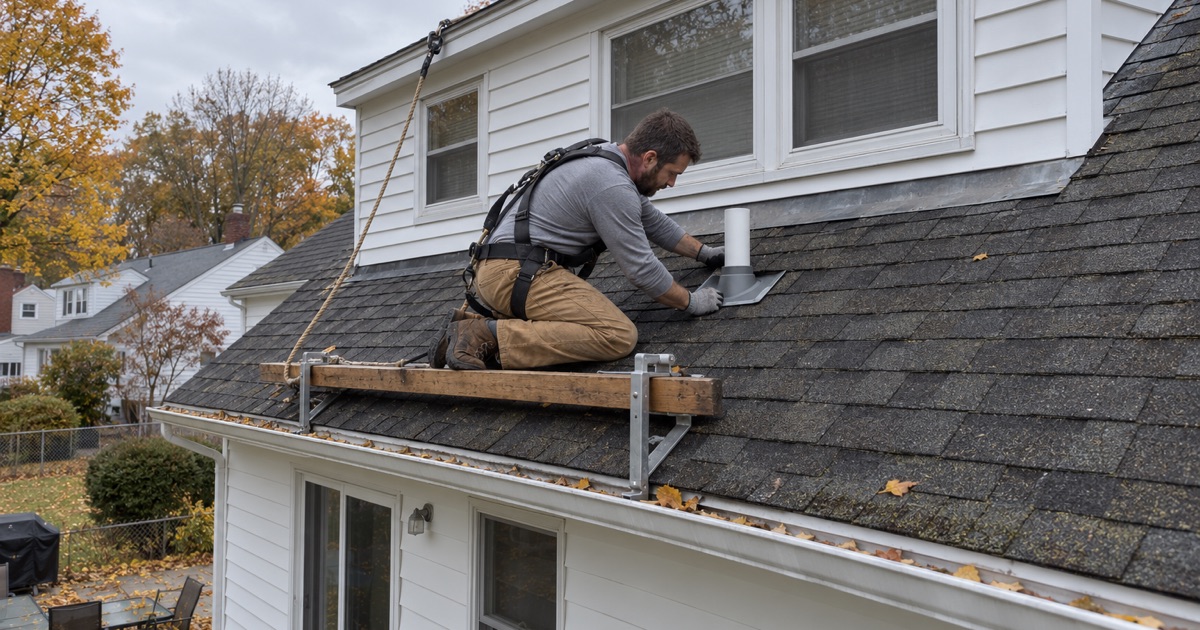
The rubber collar on a plumbing vent boot cracks as it ages in the sun, and water then runs straight down the pipe. It is one of the most common leaks we find and one of the cheapest to fix properly. We replace cracked boots with new rubber or lead flashing boots and reseat the shingles around them.
Box vents, exhaust fans and old turbine vents leak at their flashing or when their own housing cracks. We replace damaged units and flash them correctly into the surrounding shingles.
Bath and kitchen exhaust ducts are worth checking at the same time. A duct that has slipped off its roof cap dumps warm, wet air into the attic, and the staining it leaves looks a lot like a roof leak until someone follows it back to the fan.
Valleys, Skylights and Wall Joints
Valleys carry more water than any other part of a roof, so worn or poorly cut valleys leak in heavy rain. Skylights leak at the curb flashing or at the glazing seal. Where a lower roof meets a wall, missing or reversed step flashing and missing kick-out flashing send water behind the siding. Each gets its own repair method rather than a general patch.
A valley repair usually means lifting the shingles on both sides, replacing the valley lining and reinstalling or replacing the shingles with a clean cut line. A skylight curb gets new step flashing or a manufacturer flashing kit, and a wall joint gets new step flashing woven course by course with the shingles.
Leaks at the Eaves and Gutters
Leaks at the edge of the roof are often ice dams in winter or water running behind a gutter that was hung too low or installed with no drip edge. We add drip edge, correct gutter height and pitch, and install self-adhering ice and water barrier along the eaves where a repair section allows. Rotted fascia behind the gutter is replaced before the gutter goes back on.
Repairing the Leak Properly
Fixing the Source, Not the Symptom
A lasting leak repair replaces the part that failed. That means new flashing, new boots, new shingles properly lapped and nailed, and repaired decking where water has softened it. Damaged decking is photographed and shown to you before it is replaced, at a per-sheet price agreed in advance.
After the repair, we go back into the attic where possible to confirm the area is drying and no new water is coming in. If we water-tested to find the leak, we test again after the repair. That second check is what tells you the leak is actually gone rather than just quiet until the next storm.
Temporary Dry-In for Active Leaks
When a leak is active and a full repair cannot be completed right away, we dry in the area with underlayment or a secured tarp to stop more water from entering. The permanent repair follows as soon as weather and materials allow. A temporary fix is described as temporary on our paperwork, so nobody mistakes it for the finished job.
Storm Leaks and Insurance
If a storm caused the leak, we photograph the damage and write it up for your own insurance claim, and we will meet the adjuster on site when asked. We do not negotiate the claim; under Pennsylvania’s Public Adjuster Licensing Law that is the job of a licensed public adjuster or the owner. Keep receipts for any emergency measures, since many policies reimburse reasonable steps to prevent further damage.
When a Leak Means a Bigger Problem
Repeated Leaks in Different Places
One leak is usually a repair. Leaks appearing in several places at once, on a roof with heavy granule loss and curling shingles, suggest the roof as a whole is reaching the end of its life. We tell you honestly whether another repair will hold or whether replacement is the better use of your money, and we put the reasons in writing.
Even then, a targeted repair can make sense as a bridge. If replacement is a year or two away, fixing the worst leak keeps the decking and insulation dry while you plan the budget, choose materials and schedule the work for good weather.
- 20+ Years Roofing
- Itemized Written Scopes
- Repair Before Replace